Today’s Teaching Strategy: Rhythms for Free (in d minor)

(Instrumental Improvisation)
Elementary (Gr. 3-4)
© 2026 Darla S. Hanley
This teaching strategy is all about improvising rhythmic patterns on Orff instruments using 3 pitches. It goes with “Soul Jazz Experience” by Mister T. (2013) because its harmonic foundation supports this music making and the track has a cool vibe!
Pedagogical Foundations
Set me up! No really, set me up for success, please (lol).
Students need guardrails and bumpers. They need direction and inspiration—prompts to get them to act and do. In music class, we often set students up without even thinking about it (lol). We do things like remove bars from xylophones to only have students explore notes that fit a tune; display instruments by category (e.g., woods, shakers, drums) so students can see the groupings as well as hear them; and ask them to make music by rote before reading.
We also set students up for success by asking guiding questions and/or dropping hints when they are close to the answer we are seeking—rather than quickly telling the answer.
Further, we set up the music room in such a way that supports student learning; flow of instruction; and space for movement, small groups, centers, etc. We also set up the sequence of the instruction moving from concepts and skills that are familiar—to the unfamiliar; beginning with something fast-paced and engaging OR a warm-up to prepare students for music making; and varying the activities like singing, playing, chanting, moving, etc. to work within attention spans and focus, for example.
Everything we do in the classroom is designed (or should be—lol) with teachable moments that set students up to try and do their very best. And we all know, the pre-class planning and prep can be super time consuming as we consider all of the moving parts and possibilities. In my view, this is time well spent when students enter the music room and everything is r-e-a-d-y for them!
Call to Action
Look around your school for a teacher who clearly puts the time in for students—in all the ways—and send them a note of appreciation. “Our students are fortunate to have you as a teacher. I wanted you to know that I notice how you always go above-and-beyond for them!” (And you decide if you sign it, or send it anonymously…both ways are impactful.)
Today’s teaching strategy includes the opportunity for students to explore rhythmic patterns using prepared barred instruments and unpitched percussion! I hope you give it a try with your students. But first, let me remind you who I am:
Hi! I’m Darla, an experienced PK-12 music educator, college professor, and former Berklee College of Music Dean looking to connect with teachers, parents/caregivers, and others seeking to advance creative music making for today’s students—and their teachers. In Darla Hanley’s Music Room you will find teaching strategies, advice and teaching tips, playlists, and more.
Today we are going to play instruments with a track—and improvise rhythms! The name of the music is “Soul Jazz Experience” and it’s by an artist called Mister T.
Invite students to move to the (prepared) barred instruments.
ProTIP: Remove all bars on the instruments except d, f, and a.
ProTIP: Divide students into instrument players and body percussion if there aren’t enough Orff instruments for everyone to play. Have the body percussion group perform a clapping ostinato.
You will see we have 3 notes ready to play today: d, f, and a. Take a minute to practice playing these notes and remember to use your best mallet technique with relaxed wrists and a light touch.
ProTIP: This practice time gives students a chance to recall how to hold mallets and play the instrument. Watch for students who may be having difficulty—or who are a bit heavy-handed (lol) and offer guidance.
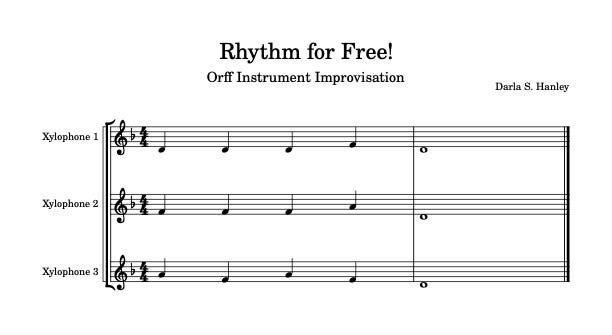
Lead students to play the 3 xylophone parts in “Rhythm for Free!”. Once comfortable, divide the class into 3 groups, assign Xylophone 1, Xylophone 2, and Xylophone 3, and direct students to play these parts (without the track).
ProTIP: Isolating the parts (individually), then building to have all 3 parts being played—ahead of adding the track is a best practice.
Now that you can play “Rhythm for Free” let’s add the recording! Play “Soul Jazz Experience” and direct students to perform all parts with the track.
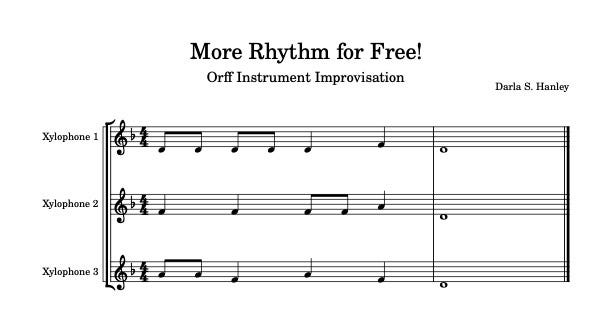
Teach the “More Rhythm for Free” variation and lead students to perform these parts with the track.
How is “More Rhythm for Free” like “Rhythm for Free”? (The parts use the same notes) How is it different? (The original has only “Ta” rhythms; “More…” has “Ta” and “Ta-di” rhythms)
And now we will improvise new rhythms using the same notes! You may play any rhythmic pattern you know or try new ones. Be sure to play the same notes (the d, f, and a as they come up in your part) as you change *only* the rhythm.
Play the recording and invite students to improvise new rhythmic patterns on their Orff instrument along with the track.
Rhythm For Free
More Rhythm For Free
© 2026 Darla S. Hanley
Materials/Set Up
Orff Instruments and Mallets
Variety of Unpitched Percussion Instruments
Recorders (Optional)
🎵 Mister T. "Soul Jazz Experience” (2013) Link to Track on Spotify
EXTEND the Learning:
Select a small group of students to go to the unpitched classroom percussion collection and choose instruments to play. Invite these students to improvise rhythmic patterns using a conducted (point-and-play) approach between this group and the rest of the class.
ProTIP: Begin with all students (except those in the small group) improvising on the Orff instruments to continue from the previous activity. Then inform students that they need to watch carefully to know when to play! Alternate between pointing to the class and to the small group.
ProTIP: This could also be an opportunity to point to individual students for a solo assessment (in either group)!
Play the “Rhythms for Free” and “More Rhythms for Free” on a soprano recorder for students to hear as an example.
Distribute recorders, 1 per student. Now it’s your turn to play your soprano recorder! You need to play the note “a” using the rhythms from our xylophone parts.
Play the recording and direct students to play each xylophone part on their recorder.
ProTIP: Group students to create Orff instrument Xylophone 1 with recorder players playing those rhythms, Xylophone 2, etc. and continue the point-and-play from above.
Learning Targets
Play, Improvise
Learning Outcomes
Respond using instruments
Create original rhythmic pattern combinations
Perform in 3 parts and with original expressions
Assessment
Informal Observation/Formative Assessment
Formal Observation/Summative Assessment*
*This is optional depending how the point-and-play activity is lead.
Thanks for checking this out. If you use this teaching strategy, be sure to leave a comment to let me know how it resonates with your students!
Oh man, you and Mr T had me boppin around the kitchen waiting for supper to finish! Seriously though, I love the idea about writing a note of praise to a fellow teacher. How cool. We all long to be seen.